You get a flat, you go to buy a tube, and the numbers don't line up. Your tire says one thing, the tube box says something that looks like a range, and the shop has three valve types on the shelf. It's a common moment of doubt, and it has a simple answer once you know which number to trust.
This guide shows how to read the size off your tire, how to read the range printed on a tube, and how to choose the valve. We use one manufacturer's published tube data (Schwalbe) for the examples, because a real data sheet is easier to follow than a generic chart.
Start with the tire, not the wheel
Before you look at any tube, read the tire sidewall. Most bicycle tires carry two kinds of size marking:
- an inch size such as 26 × 1.95 or 700 × 25C
- an ETRTO size such as 50-559 or 25-622
The ETRTO number is the one to use. Schwalbe explains it in its tire-size FAQ: "The ETRTO size designation (e.g. 37-622) indicates the width (37 mm) and the inner diameter of the tire (622 mm)." It adds that this designation "is unambiguous and allows a clear assignment to the rim size."
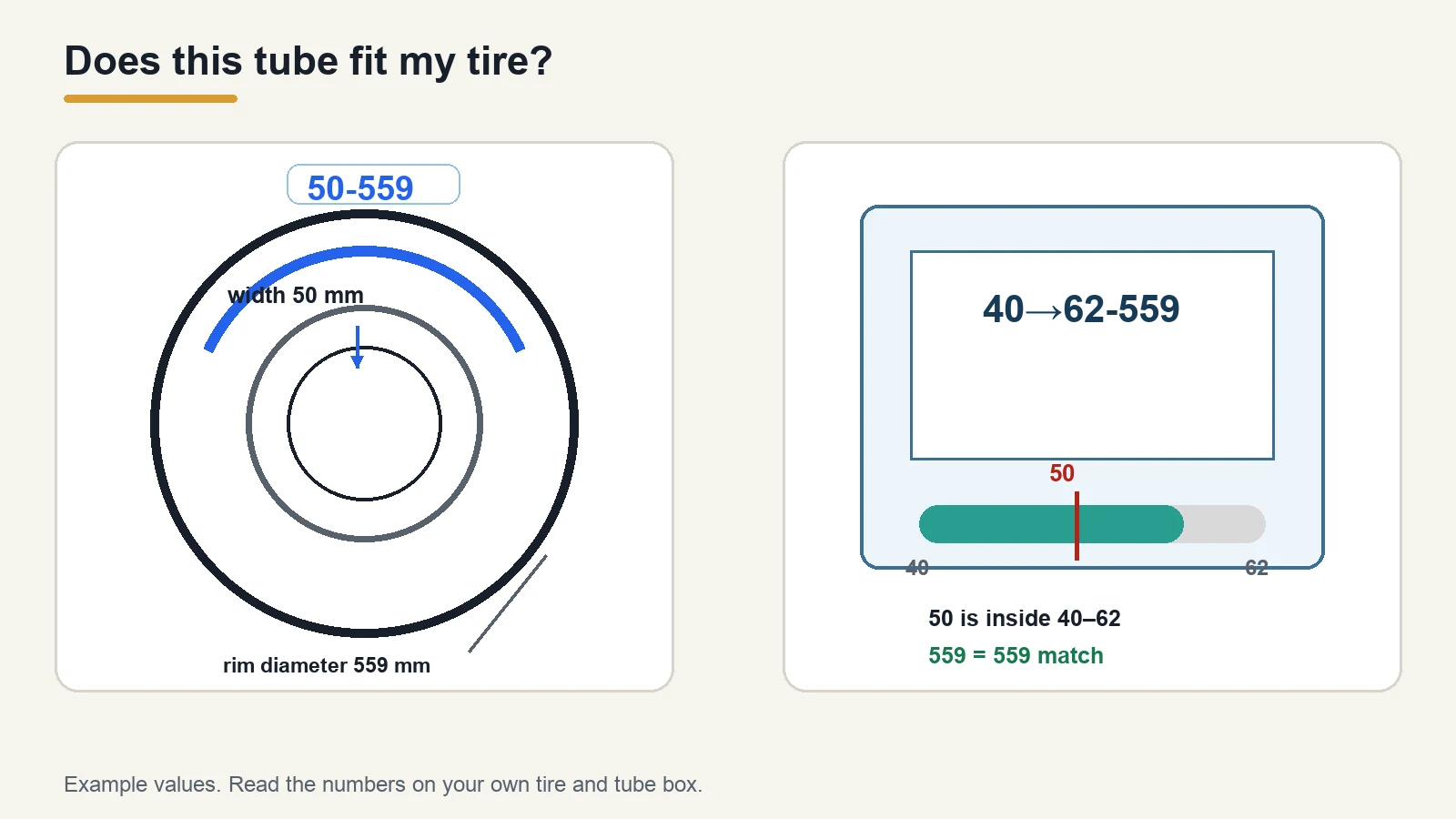
So in 50-559, the tire is about 50 mm wide and fits a 559 mm rim. In 25-622, it's about 25 mm wide on a 622 mm rim. Inch sizes are less reliable because the same inch label has been used for different rim diameters over the years. If you want the full background, our guide to ETRTO bicycle tire sizes covers it, and how to read a tire sidewall shows where the markings sit.
Write down both numbers: the width (the first number) and the diameter (the second).
How tube sizes are written
A tube is made of stretchy rubber, so one tube can fill a range of tire widths. That's why tube sizes are printed as ranges, not single sizes.
Schwalbe writes the range two ways on its product pages. Its standard 26-inch tube, No. 13, lists:
- ETRTO: 40/62-559
- Size range: 40→62-559
Both mean the same thing: this tube is for tires from 40 mm to 62 mm wide on a 559 mm rim. The product description says it plainly: "For bicycle tires in size 26" inch (ETRTO 40→62-559)."
Two rules follow:
- The diameter must match. A 559 tube is for 559 tires. Don't use a tube made for a different diameter.
- Your tire width must sit inside the tube's width range. Every Schwalbe tube page also carries this warning: "This product is only suitable up to a certain maximum tire width. For larger widths, a different product is required."
Matching your tire to a tube: worked examples
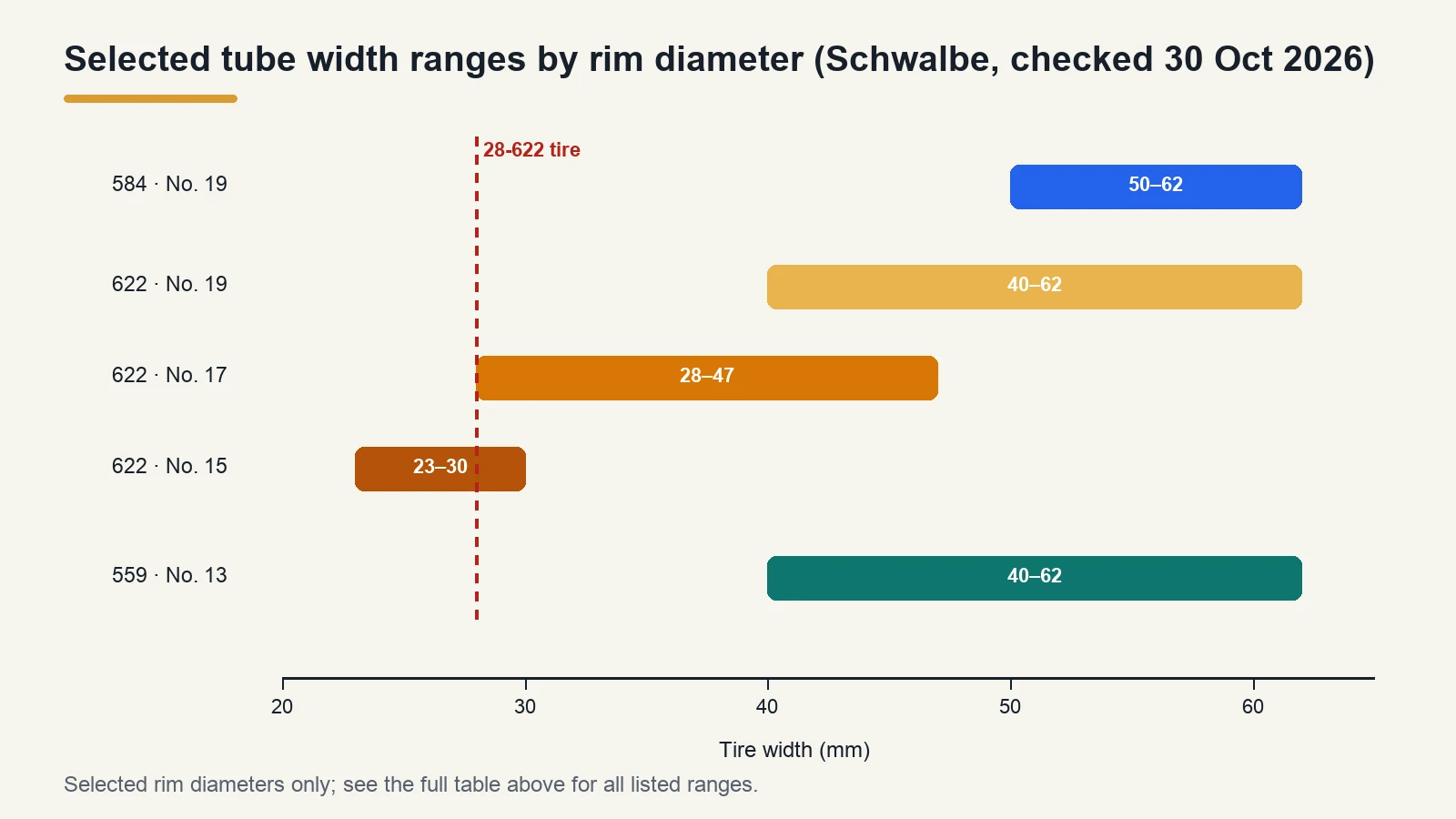
Here are four Schwalbe tubes as listed on schwalbe.com when we checked them on 30 October 2026. The ranges are copied exactly from each product page.
| Schwalbe tube | Wheel | Range on the product page | Valve types offered | Valve lengths offered |
|---|---|---|---|---|
| No. 13 | 26″ | 40→62-559 | AV, DV, SV, SCV | 40 mm, 60 mm |
| No. 15 | 28″ | 23→30-622, 25-630 | AV, DV, SV, SCV | 40, 50, 60, 80 mm |
| No. 17 | 28″ | 28→47-622, 32-630, 40-609, 40-635 | AV, DV, SV, SCV | 40, 50, 60, 80 mm |
| No. 19 | 27.5″ / 28″ / 29″ | 50→62-584, 40→62-622, 40-635 | AV, DV, SV, SCV | 40, 50, 60 mm |
These are Schwalbe's own ranges for Schwalbe tubes. Other brands set their own ranges, so always read the box of the tube you're actually buying.
Example 1: a mountain bike tire marked 26 × 1.95. Find the ETRTO number on the same sidewall. Suppose it reads 50-559. The diameter is 559 and the width is 50. Tube No. 13 covers 40 to 62 on 559, so 50 sits comfortably inside. That tube fits.
Example 2: a road tire marked 700 × 28C. Suppose the sidewall reads 28-622. Tube No. 15 covers 23 to 30 on 622, and tube No. 17 covers 28 to 47 on 622. A 28 mm tire is inside both ranges, right at the top of one and the bottom of the other. Either tube would be listed as suitable. This is also the answer to the common question "can I put a 700 × 25C tube in a 28C tire?": check the range printed on that tube. If 28 is inside it, yes. If the range stops below 28, choose the next tube up.
Example 3: a 29er tire marked 29 × 2.35. Suppose the ETRTO reads 60-622. Tube No. 19 lists 40→62-622, so 60 is inside the range.
Example 4: a tire that falls between two tubes. If your tire width sits outside a tube's range, don't stretch the rule. Pick the tube whose range contains your width.
Choosing the valve type
Bicycle tubes come with different valves, and the valve has to fit the hole drilled in your rim and the pump you own. Schwalbe uses three common abbreviations:
- AV: the same type of valve as on a car tire, often called Schrader
- SV: the slim valve with a small locknut at the tip, often called Presta
- DV: the Dunlop (Woods) valve, common on European city bikes
Schwalbe also lists its own SCV option on these pages.
The simplest rule is to replace like with like. Look at the old tube's valve and buy the same type. A slim SV valve in a rim drilled for the wider AV valve can move around in the hole. An AV valve won't go through a hole drilled for SV at all.
Choosing the valve length
This is where deep rims catch people out. Schwalbe offers the same tube with different valve lengths: 40 mm and 60 mm for No. 13, and 40, 50, 60 and 80 mm for No. 15 and No. 17.
Schwalbe doesn't publish a rule for choosing the length. The logic is simple, though: the valve has to pass all the way through the rim and still leave enough sticking out for your pump head to grip. A low-profile rim works with a short valve. A deep-section rim needs a longer one. Measure from the rim bed (where the tube sits) to the outer edge of the rim, then choose a valve that's clearly longer than that.
If you're unsure, your old tube is the best reference: if the pump fitted it easily, buy the same length. If you struggled to get the pump head on, go up a size.
A quick buying checklist
- Read the ETRTO number on the tire sidewall (for example 50-559).
- Find a tube whose range includes your width and has the same diameter.
- Match the valve type to the old tube and the rim hole (AV, SV or DV).
- Pick a valve length that clears your rim depth with room for the pump.
- Check the tube material too. Our guide to butyl vs natural rubber inner tubes explains the difference.
When the new tube is in, set the pressure according to the tire and rim maker's recommendation for your load and terrain, and never exceed the maximum marked on the tire or rim. Our tire pressure converter switches between PSI, bar and kPa if your pump uses different units.
FAQ
What size inner tube do I need?
One whose printed range includes your tire's ETRTO width and has the same diameter. If your tire reads 50-559, you need a 559 tube whose range covers 50, such as one listed as 40→62-559.
Can I use a 26 × 1.75–2.125 tube in a 26 × 1.95 tire?
Check the ETRTO numbers rather than the inch labels. If the tube's range covers your tire's ETRTO width and the diameter is the same (559 for most modern 26-inch mountain bikes), it's suitable.
Can I use a 700 × 25C tube in a 28C tire?
Only if the tube's printed range includes 28 mm. For example, Schwalbe lists its No. 15 tube as 23→30-622, which includes 28. If a tube's range stops at 25 or 26, choose a larger one.
What do AV, SV and DV mean on a tube box?
AV is the car-type (Schrader) valve, SV is the slim Presta valve, and DV is the Dunlop (Woods) valve. Buy the same type as your old tube so it fits the rim hole and your pump.
How long should a Presta valve be for a deep rim?
Long enough to pass through the rim and leave room for the pump head. Measure the rim depth and pick a valve clearly longer than that. Schwalbe, for example, offers lengths from 40 mm up to 80 mm on some tubes.
Sources
| Source | URL | Checked |
|---|---|---|
| Schwalbe, Tube No. 13 (26″) product page | https://www.schwalbe.com/en/SCHWALBE-TUBE-13-26-10462140 | 20261030 |
| Schwalbe, Tube No. 15 (28″) product page | https://www.schwalbe.com/en/SCHWALBE-TUBE-15-28-10465144 | 20261030 |
| Schwalbe, Tube No. 17 (28″) product page | https://www.schwalbe.com/en/SCHWALBE-TUBE-17-28-10464994 | 20261030 |
| Schwalbe, Tube No. 19 (27.5″/28″/29″) product page | https://www.schwalbe.com/en/SCHWALBE-TUBE-19-27.5-28-29-10464801 | 20261030 |
| Schwalbe, Technology FAQ: Tire sizes | https://www.schwalbe.com/en/technology-faq/tire-sizes/ | 20261030 |