You check the tread and there’s plenty left. Then you find the date code on the sidewall and realize the tire is eight years old. Is it still fine?
Manufacturer recommendations don’t all use the same wording, and the internet is full of confident numbers: five years, six years, seven, ten. This guide sticks to what tire manufacturers publish on their own websites, puts their wording side by side, and shows you how to find your tire’s real age. We won’t hand you a universal cut-off, because the companies that make the tires don’t give one that applies to every situation either.
Start with the tire’s real age: the DOT date code
A tire’s age counts from the day it was made, not the day it was fitted or bought. Both manufacturers quoted below measure from the date of manufacture.
That date is in the DOT code on the sidewall. Continental explains it plainly: “The last four numbers denote the fabrication date of the tire to the nearest week.” Its own example is a tire marked DOT XXXXXXX2714, which “has a manufacture date from the 27th week of 2014.”
So:
- the first two of the last four digits are the week (01–53)
- the last two are the year
If you’d rather not count weeks by hand, type the four digits into our DOT date code decoder. It tells you the build week and how old the tire is today. If you’re not sure where the code is, our sidewall reading guide shows where to look.
Continental also notes that tires produced before 2000 have three digits instead of four. If you find a three-digit date code, the tire is from the 1990s or earlier.
What the manufacturers say, side by side
Here’s each company’s published position, in its own words. We’ve only included companies whose official pages we could open and read on 28 October 2026.
Michelin
Michelin’s US site sets out two milestones:
- After five years: “After five years of service, tires should be thoroughly inspected at least once a year by a trained tire professional.” Michelin adds that this applies “even if the tires appear to be in good condition and have not yet reached the treadwear indicators.”
- At ten years: “As a precaution, Michelin recommends replacing tires ten years after their date of manufacture, regardless of remaining tread depth or apparent condition. This recommendation includes spare tires.”
Michelin also says that for vehicles fitted with original equipment tires, you should “always follow the vehicle manufacturer’s recommendations for tire replacement.”
Continental
Continental’s “Replacing tires” page is just as direct on the upper limit: “All tires (including spare tires) more than ten years old should be removed from service and replaced with new tires.”
It says you should follow that advice even if the tires “seem to be in good condition and appear usable based on their external appearance” and even if tread wear “has not passed the minimum legal limit.”
It’s also unusually honest about the evidence: “Continental is not aware of any technical data to support the removal of service for tires past a specific age.” Its reasoning is that age matters for tires as it does for any other part of a car.
And, like Michelin, it defers to the car maker: “Some vehicle manufacturers may recommend a different chronological age at which to replace a tire... Continental recommends drivers to pay heed to these instructions.”
Where they agree, and where they don’t
| Michelin | Continental | |
|---|---|---|
| Counts from | Date of manufacture | Date of manufacture (DOT date) |
| Inspection milestone | Yearly professional inspection after 5 years of service | Not given as a year figure on the page we read |
| Upper limit | Replace 10 years after manufacture | Remove from service after 10 years |
| Spare tires included | Yes | Yes |
| Applies even with good tread | Yes | Yes |
| Vehicle maker’s own limit | Follow it (for original equipment tires) | Pay heed to it |
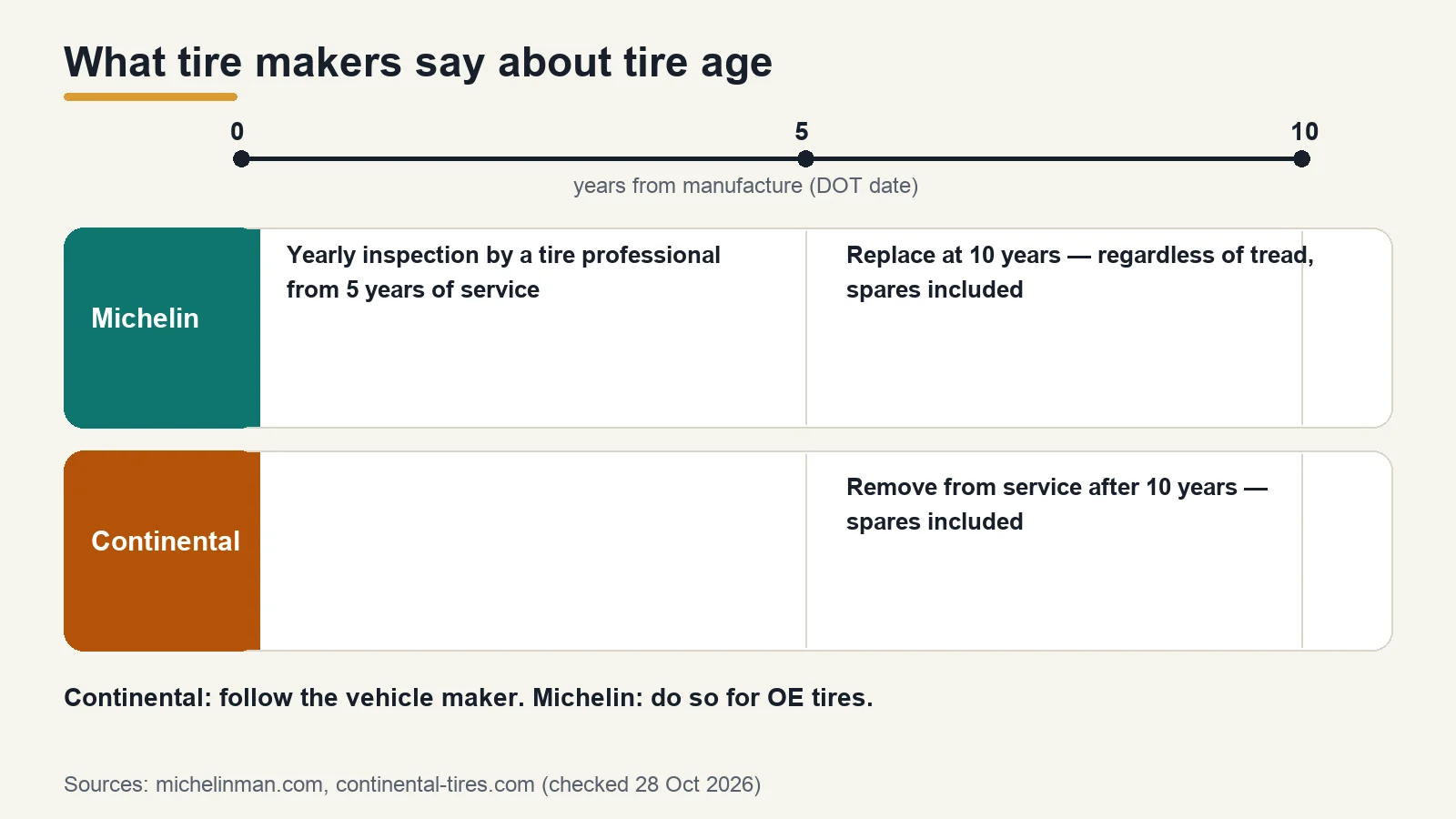
Two things stand out. First, both put the outer limit at ten years from manufacture, spares included, whatever the tread looks like. Second, neither says a tire is safe right up to its tenth birthday. Michelin builds in yearly inspections from year five. It also says original-equipment tires should follow the vehicle maker’s replacement guidance, while Continental tells drivers to follow any different age a vehicle maker recommends.
What about the “6-year tire rule”?
You’ll see “replace tires every six years” repeated online. We couldn’t find that figure on either manufacturer’s page above, so we can’t attribute it to them.
Both pages do point you to the vehicle manufacturer: Michelin for original-equipment tires, Continental more broadly. In either case, the practical move is to check your owner’s manual or the maker’s maintenance schedule. If it gives an age, that’s the number for your car, even if it’s lower than ten.
Do tires expire if they’re never used?
Not on a printed expiry date, but age still counts. Michelin says: “Over time, the materials within a tire can degrade, which may affect durability and performance even if the tire has seen limited use.” Both manufacturers include spare tires, which often sit unused for years, in their ten-year limit.
That has two practical consequences:
- Your spare. Check its date code too. A spare that has never touched the road can still be the oldest tire on the car.
- Buying “new” tires. A tire can be new and unused but not recently made. Read the DOT date before it’s fitted so you know what you’re starting with.
Age is one check, not the only one
Age doesn’t replace the usual checks; it adds to them. Michelin lists other signs worth acting on, including visible damage, vibration and changes in performance, alongside tread depth.
A simple routine:
- Read the DOT date on every tire, including the spare.
- Check the tread. Our tread depth calculator helps you turn a measurement into remaining life.
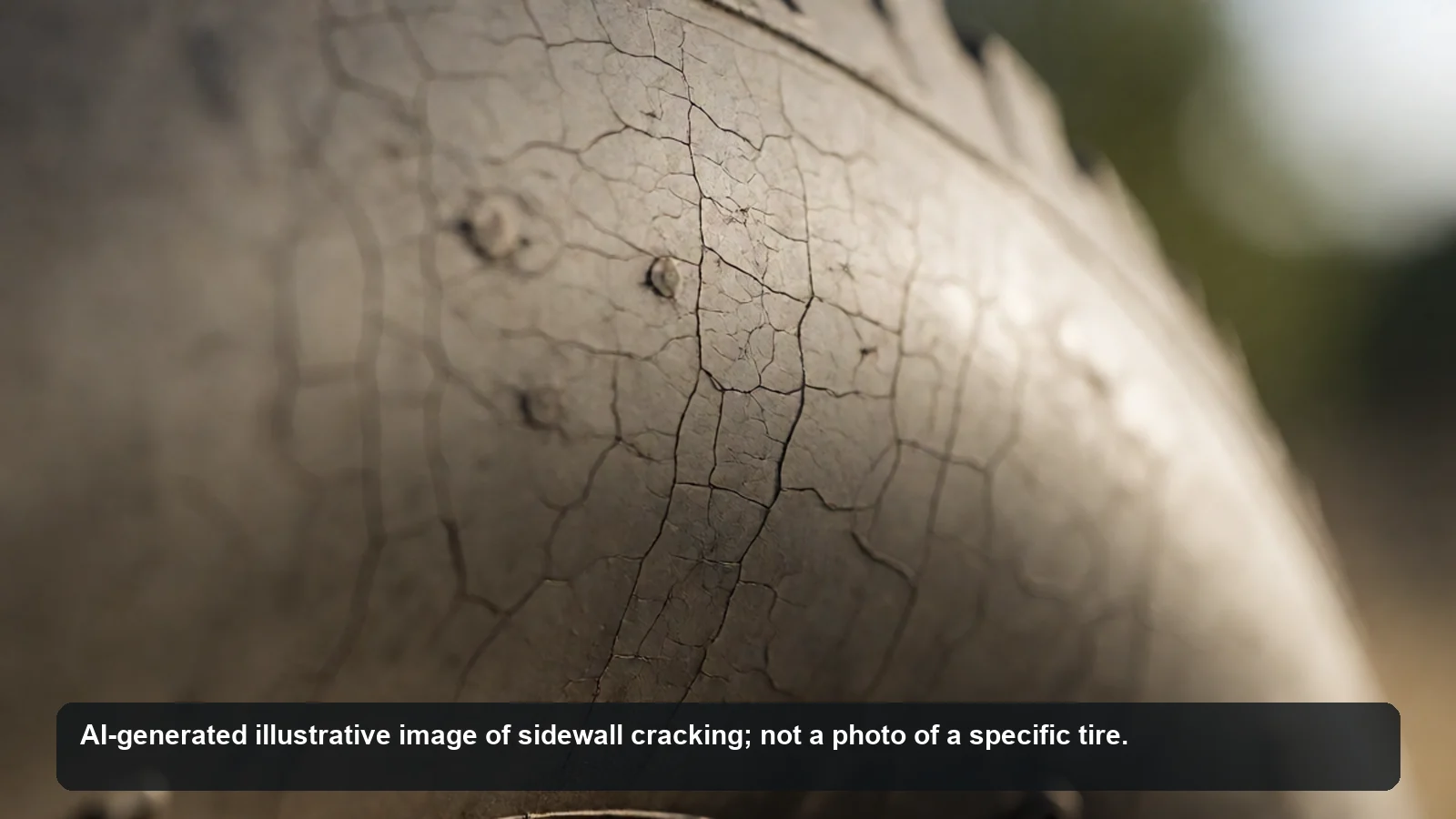
- Look at the sidewalls and tread surface. Cracks, cuts, bulges or blisters are reasons to have the tire inspected now, whatever its age.
- From year five, follow Michelin’s suggestion of a yearly inspection by a tire professional.
- At ten years from manufacture, both manufacturers say replace it, spare included.
- If your vehicle maker specifies a lower age for the tires fitted to your car, follow that.
If the tire is somewhere between five and ten years old and you’re unsure, a tire shop can inspect it. That’s the step both companies point you towards, rather than a guess based on the calendar alone.
FAQ
How do I tell how old my tires are?
Find the DOT code on the sidewall and read the last four digits: the first two are the week, the last two the year. For example, 2714 means the 27th week of 2014. Our DOT date code decoder does the arithmetic for you.
Is a 10-year-old tire with good tread safe to use?
Michelin and Continental both say to replace tires ten years after manufacture regardless of tread depth or appearance, and both include spare tires.
Do tires expire if they’re not used?
There’s no printed expiry date, but Michelin says tire materials can degrade over time “even if the tire has seen limited use.” Both manufacturers apply the ten-year limit to spares.
Where does the 6-year rule come from?
We didn’t find it on Michelin’s or Continental’s pages. Michelin says to follow the vehicle manufacturer’s recommendations for original-equipment tires, and Continental tells drivers to heed any different age a vehicle manufacturer recommends. Either way, check your owner’s manual.
Does the age count from when I bought the tire?
No. Both manufacturers count from the date of manufacture, which is the DOT date code on the sidewall.
Sources
| Source | URL | Checked |
|---|---|---|
| Michelin USA, When to Replace Tires: Wear, Age, and Safety Signs | https://www.michelinman.com/auto/auto-tips-and-advice/tire-buying-guide/when-do-i-need-new-tires | 20261028 |
| Continental Tires, Replacing tires | https://www.continental-tires.com/tire-knowledge/replacing-tires/ | 20261028 |