Look at the sidewall of almost any passenger car tire sold in the US and you’ll find a short line that reads something like TREADWEAR 500 TRACTION A TEMPERATURE A. That’s the Uniform Tire Quality Grading (UTQG) label. It looks like a score, and most people read it like one: bigger number, better tire.
That’s only half right. The grades come from a federal rule, 49 CFR 575.104, and the rule itself is fairly clear about what they do and don’t tell you. This guide walks through each of the three grades using the regulation’s own wording, so you know what you’re actually comparing when you stand in a tire shop.
If you’re still learning the rest of the sidewall code, start with our sidewall reading guide and come back here for the detail.
Which tires carry a UTQG grade?
The rule covers new passenger car tires. It specifically does not apply to:
- deep-tread, winter-type snow tires
- space-saver or temporary-use spare tires
- tires with a nominal rim diameter of 12 inches or less
- “limited production” tires (roughly, a design and size made or imported in quantities of 15,000 or fewer a year, plus a few other conditions)
So if your winter tires or your compact spare have no UTQG line, nothing is missing. Motorcycle tires aren’t passenger car tires either, which is why you won’t see these grades on them.
Who assigns the grade? The tire manufacturer or the brand name owner. The government sets the test method and runs its own compliance checks, and the regulation says each tire “shall be able to achieve the level of performance represented by each grade with which it is labeled.” But the number on the sidewall is the brand’s own claim, tested to a common method.
Treadwear: what “500” actually means
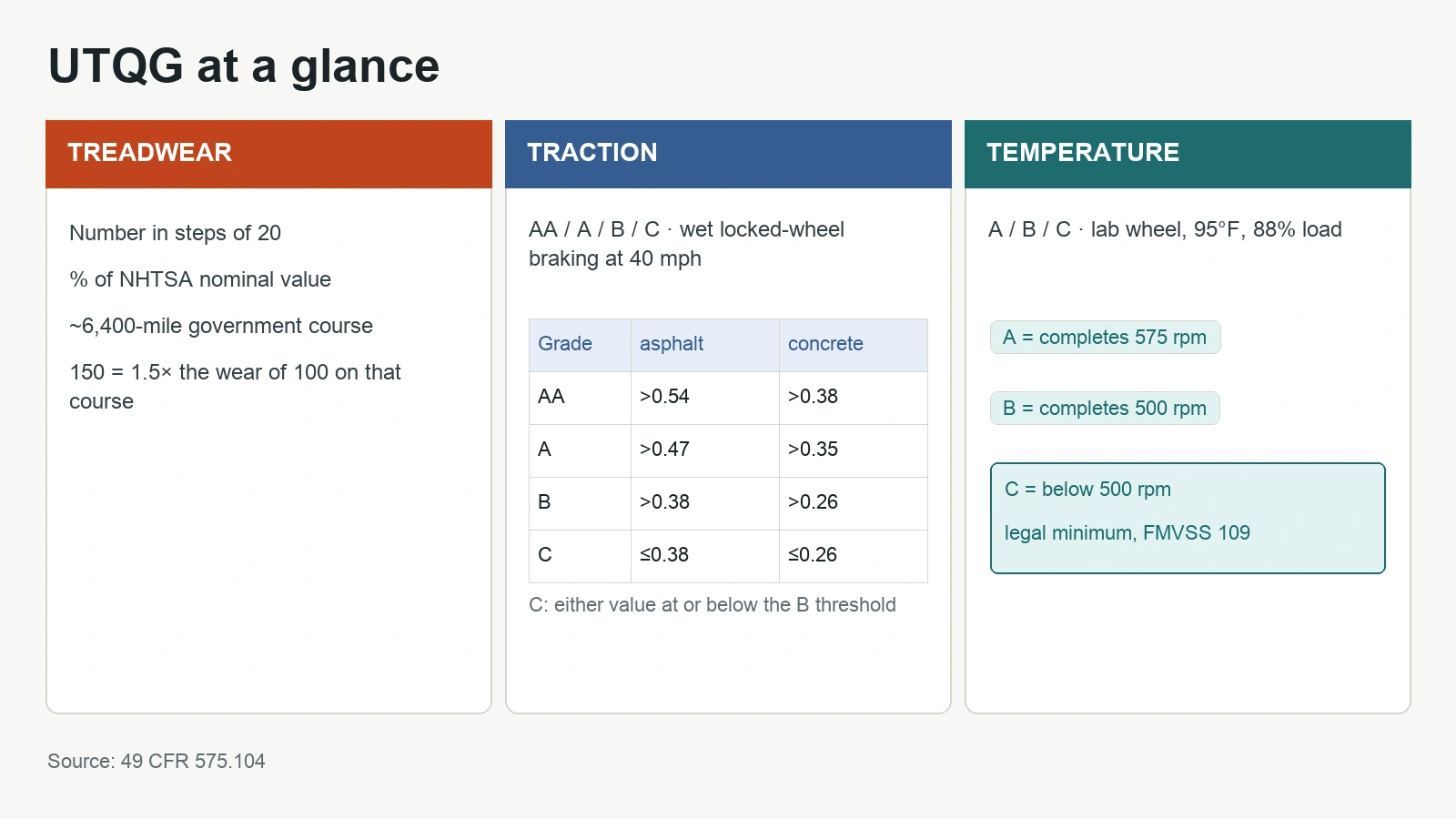
The treadwear grade is a two- or three-digit number. According to the regulation it is “expressed as a percentage of the NHTSA nominal treadwear value.” In plain terms, it’s a comparison against a reference figure, not a mileage.
How the test works
The regulation describes a public-road course of about 400 miles, set up by NHTSA near San Angelo, Texas. A convoy of vehicles runs the candidate tires alongside “course monitoring tires” that the government uses as a yardstick:
- Tires are broken in for two circuits (800 miles).
- Tread depth is measured at six equally spaced points in each groove.
- The convoy drives 16 circuits, about 6,400 miles, rotating tires after every circuit.
- The wear rate is projected from the tread-depth measurements and corrected for that run’s weather and road conditions, using how the course monitoring tires wore in the same convoy.
- The result is turned into a percentage and, in the rule’s words, rounded “to the nearest lower 20-point increment.”
That’s why grades come in steps of 20: 300, 320, 340 and so on.
How to read the number
The regulation gives its own example: “a tire graded 150 would wear one and one-half (1 1/2) times as well on the government course as a tire graded 100.”
Notice the phrase on the government course. The rule goes straight on to say: “The relative performance of tires depends upon the actual conditions of their use, however, and may depart significantly from the norm due to variations in driving habits, service practices and differences in road characteristics and climate.”
Why you shouldn’t compare brands by treadwear alone
Because each manufacturer or brand owner assigns its own grade, a 500 from one brand and a 500 from another aren’t guaranteed to mean the same real-world life. The comparison is most useful between tires from the same brand. Across brands, treat it as a rough hint and look at the warranty mileage and independent reviews too.
There’s no official formula that turns a treadwear grade into miles, so we don’t give one here. If you see a “multiply by X” rule of thumb online, it isn’t from the regulation.
Traction: AA, A, B and C
The traction grade tells you how well the tire stopped on wet pavement in a government test.
How it’s tested
A test trailer is towed at 40 mph over wet asphalt and wet concrete test surfaces. The brakes lock the test wheel, and the sliding friction coefficient is measured. The grade depends on both surfaces:
| Grade | Wet asphalt coefficient | Wet concrete coefficient |
|---|---|---|
| AA | above 0.54 | above 0.38 |
| A | above 0.47 | above 0.35 |
| B | above 0.38 | above 0.26 |
| C | 0.38 or less | or 0.26 or less |
A tire has to clear both thresholds to earn a grade. Do well on asphalt but badly on concrete, and the lower result decides.
What it doesn’t tell you
The regulation includes a warning that manufacturers must pass on to buyers: “The traction grade assigned to this tire is based on straight-ahead braking traction tests, and does not include acceleration, cornering, hydroplaning, or peak traction characteristics.”
So “AA” means good locked-wheel straight-line braking on two wet surfaces. It says nothing about grip in a wet corner, resistance to aquaplaning, or dry-road performance.
Temperature: A, B and C
The temperature grade is about how well the tire resists heat buildup at speed, tested indoors.
How it’s tested
The tire is mounted against a large steel test wheel, 67.23 inches in diameter, in a room held at 95°F. It’s loaded to 88 percent of its maximum load rating and run:
- at 250 rpm for 2 hours, then
- at 375 rpm for 30 minutes, then up in 25 rpm steps, 30 minutes each, to 575 rpm.
The grade depends on how far it gets:
| Grade | Result on the test wheel | Approx. road speed* |
|---|---|---|
| C | Does not complete the 500 rpm step | below ~100 mph |
| B | Completes 500 rpm but not 575 rpm | ~100 mph |
| A | Completes 575 rpm | ~115 mph |
*The regulation is written in rpm, not mph. The speeds are our own conversion: a 67.23-inch wheel is about 17.6 feet around, so 500 rpm works out to about 100 mph and 575 rpm to about 115 mph. Treat them as a way to picture the test, not a speed rating.
What the grade means for you
The rule says grade C “corresponds to a level of performance which all passenger car tires must meet” under Federal Motor Vehicle Safety Standard No. 109, and “Grades B and A represent higher levels of performance on the laboratory test wheel than the minimum required by law.”
It also comes with a warning worth repeating word for word: “The temperature grade for this tire is established for a tire that is properly inflated and not overloaded. Excessive speed, underinflation, or excessive loading, either separately or in combination, can cause heat buildup and possible tire failure.”
In other words, an “A” grade assumes correct pressure and load. If you run the tire low or overloaded, the grade no longer describes what’s happening. The tire pressure calculator can help with unit conversions, but the pressure your car needs is on the door-jamb placard and in the owner’s manual.
Putting it together: reading “500 A A”
Take a sidewall that reads TREADWEAR 500 TRACTION A TEMPERATURE A:
- 500: on the government course, this tire’s projected wear came out at 5 times the NHTSA nominal value (rounded down to the nearest 20). Compare it with other tires of the same brand rather than across brands.
- Traction A: on the 40 mph wet locked-wheel test, it beat 0.47 on asphalt and 0.35 on concrete, but didn’t reach the AA thresholds. Straight-line braking only.
- Temperature A: it completed the 575 rpm step on the lab wheel at proper inflation and 88% load.
Things the label doesn’t cover at all: dry grip, cornering, noise, comfort, snow performance, and how old the tire is. For age, check the DOT date code with our DOT date code decoder. For remaining tread, try the tread depth calculator.
FAQ
Is a higher treadwear number always better?
Higher means it wore more slowly on the government course than a lower-graded tire from the same grading system. But grades are assigned by each manufacturer or brand owner, and the regulation warns that real-world wear “may depart significantly from the norm.” Use it to compare within a brand, not as a mileage promise.
What’s the difference between traction AA and A?
AA needs a wet locked-wheel coefficient above 0.54 on asphalt and above 0.38 on concrete; A needs above 0.47 and above 0.35. Both are straight-line braking tests at 40 mph and don’t measure cornering or hydroplaning.
Does temperature grade A mean I can drive at 115 mph?
No. The test is run in rpm on a lab wheel; the mph figure is only our conversion to help picture it. The tire’s speed rating is a separate mark on the sidewall, and the grade assumes correct inflation and load.
Why don’t my winter tires have a UTQG grade?
Deep-tread winter-type snow tires are excluded from 49 CFR 575.104, as are temporary spares, tires for rims of 12 inches or less, and limited-production tires.
Do motorcycle tires have UTQG ratings?
The rule applies to passenger car tires, so motorcycle tires aren’t graded under it.
Sources
| Source | URL | Checked |
|---|---|---|
| eCFR, 49 CFR 575.104 Uniform tire quality grading standards | https://www.ecfr.gov/current/title-49/section-575.104 | 20261026 |