It's popular because bigger wheels change how a car looks and how the tire feels. But the size on your sidewall also affects your speedometer, how much load the tire can carry, and whether the tire fits in the wheel arch. This guide shows how to do the math for any size, works through three examples, and explains why your car's list of approved sizes is the real deciding factor.
The idea behind plus sizing
A tire size like 205/55R16 describes three dimensions:
- 205: the section width in millimeters.
- 55: the aspect ratio. Michelin describes it as "the ratio between the height of the sidewall of a tyre and the width of the tyre", in percent.
- 16: the rim diameter in inches.
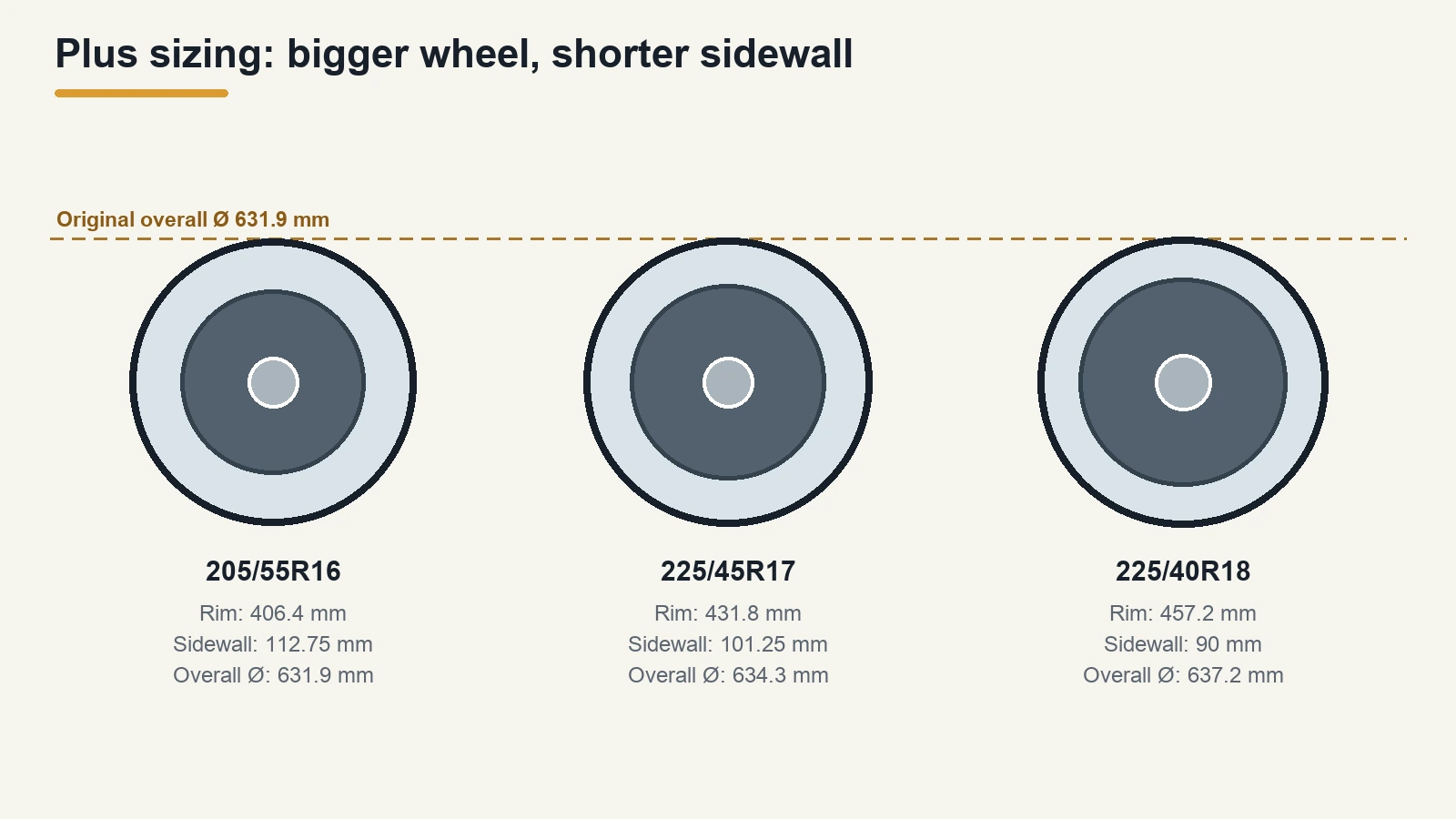
When the wheel gets bigger, the sidewall has to get shorter for the whole tire to stay close to its original diameter. That's why plus sizes usually have a lower aspect ratio and often a wider section width. If you need a refresher on the rest of the sidewall markings, see our guide on how to read a tire sidewall.
How to calculate overall diameter
You can work out a tire's nominal overall diameter from its size:
- Sidewall height = width × aspect ratio ÷ 100
- Rim diameter in mm = rim inches × 25.4
- Overall diameter = rim diameter + 2 × sidewall height
For 205/55R16:
- 205 × 55 ÷ 100 = 112.75 mm
- 16 × 25.4 = 406.4 mm
- 406.4 + 2 × 112.75 = 631.9 mm
The circumference is the diameter × π, about 1,985 mm for this size. That's how far the car moves in one turn of the wheel.
These are nominal figures. A mounted tire's real diameter varies a little with the tire model, the rim width, the load and the tread wear.
How to calculate the speedometer difference
Michelin notes that "as the speedometer takes into account the diameter of your wheels, the speed displayed on your dial could be inaccurate" if you change size. You can estimate how much:
True speed = indicated speed × new diameter ÷ original diameter
And the percentage change in diameter:
Change (%) = (new diameter − original diameter) ÷ original diameter × 100
If the new tire is bigger, each turn of the wheel covers more ground, so you're going a little faster than the dial says. If it's smaller, you're going a little slower. The odometer is off by the same percentage.
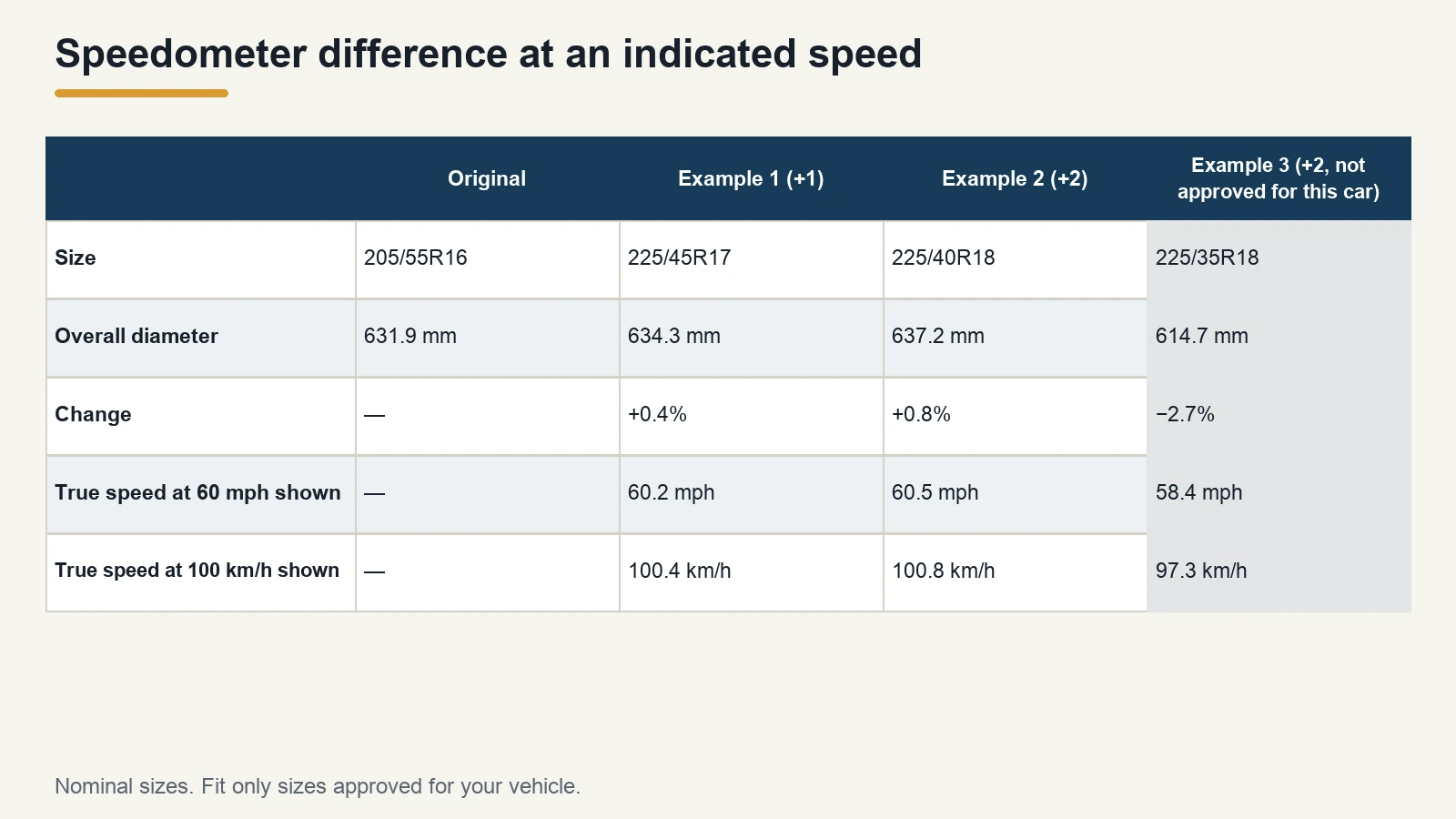
Three worked examples
All three start from 205/55R16. We ran each through our tire size comparison calculator and checked the numbers in Python with the formulas above.
The first two sizes come from a real example. Michelin lists the sizes the manufacturer approved for a 2021 Peugeot 308 1.2 PureTech: 195/65 R15 91H, 205/55 R16 91V, 205/50 R17 93V, 225/45 R17 91V and 225/40 R18 92V. The third size is not on that list; it's there only to show what the math looks like when the diameter moves further.
| Original | Example 1 (+1) | Example 2 (+2) | Example 3 (+2, not approved for this car) | |
|---|---|---|---|---|
| Size | 205/55R16 | 225/45R17 | 225/40R18 | 225/35R18 |
| Sidewall height | 112.75 mm | 101.25 mm | 90 mm | 78.75 mm |
| Overall diameter | 631.9 mm | 634.3 mm | 637.2 mm | 614.7 mm |
| Change in diameter | — | +0.4% | +0.8% | −2.7% |
| True speed at 60 mph shown | — | 60.2 mph | 60.5 mph | 58.4 mph |
| True speed at 100 km/h shown | — | 100.4 km/h | 100.8 km/h | 97.3 km/h |
Example 1: 205/55R16 to 225/45R17
The wheel grows by one inch (25.4 mm). The sidewall drops from 112.75 mm to 101.25 mm, so the diameter only grows from 631.9 mm to 634.3 mm, about 0.4%. At an indicated 60 mph, you'd be doing about 60.2 mph. The tire is also 20 mm wider, which matters for clearance.
Example 2: 205/55R16 to 225/40R18
Two inches more wheel, and the sidewall shrinks to 90 mm. The diameter is 637.2 mm, about 0.8% bigger. That's 60.5 mph at an indicated 60, or 100.8 km/h at an indicated 100.
Example 3: 205/55R16 to 225/35R18
Here the sidewall is too short to make up for the bigger wheel: 78.75 mm. The diameter drops to 614.7 mm, 2.7% smaller than the original. At an indicated 60 mph you'd only be doing about 58.4 mph, and the odometer would count more miles than you actually drove. This size isn't on the manufacturer's list for that car, and the math shows one reason why it doesn't match.
Why the approved sizes come first
The math tells you how a size compares. It doesn't tell you whether you're allowed to fit it.
Michelin's guidance is clear: "It is imperative to respect the sizes approved by the manufacturer." The approved sizes, it says, "are usually indicated on the sticker in the driver's door or in the owner's manual, sometimes also in the fuel filler flap."
Michelin also mentions that "in some countries, an exemption is possible provided that the tyre diameter remains within a limit of no more than -2% and +1.5%." That's a legal exemption in some places, not a safety rule you can apply everywhere, and Michelin still recommends sticking to the approved sizes. It lists risks of not doing so, including safety risks, fines, failing a vehicle inspection and not being covered by your insurance.
So the order is:
- Check your door sticker or owner's manual for the sizes approved for your car.
- If the size you want isn't listed, ask the vehicle manufacturer or a tire dealer before buying.
- Use the math above to understand the differences between approved sizes, not to approve a size yourself.
Other things that change with the size
Load index and speed rating
Each tire carries a load index and a speed rating. Michelin describes the load index as "an index that corresponds to a maximum load that can be supported by a single tyre." A lower-profile tire in a new size can have a different load index from the original. In the Peugeot example, the approved sizes range from 91 to 93.
Michelin says you can choose a higher load index or speed rating than the manufacturer specifies, "but in no case should it be lower." Compare the numbers on the new tire with the ones in your owner's manual.
Width and clearance
Plus sizes are often wider. Michelin warns that non-approved sizes could be "too wide and protrude dangerously beyond the width of the vehicle." A wider tire can also rub on suspension parts or the wheel arch liner. Check at full steering lock, and have a fitter check it if you're unsure.
Pressure
Start with the pressure in the owner's manual or on the door placard for the approved tire size and load. If your size is not listed, ask the vehicle or tire manufacturer for the correct pressure and do not assume the pressure for the original size still applies. Our tire pressure converter handles PSI, bar and kPa if your gauge uses a different unit.
All four at once
Michelin says "it is imperative that all four tyres are re-sized at the same time, not just two tyres on the same axle." If you're changing size, budget for a full set.
Does plus sizing affect the spare?
Your spare wheel was chosen for the original size. If you change all four wheels and tires, check what the spare is meant for and what your owner's manual says about using it. Our guide to spare tire types explains the differences between full-size, temporary and run-flat setups.
Frequently asked questions
What does plus one tire size mean?
It means fitting a wheel one inch larger in diameter, with a tire that has a lower sidewall, so the overall diameter stays close to the original. For example, 205/55R16 to 225/45R17.
Can I put bigger tires on my car?
Only sizes approved for your vehicle. Michelin says the approved sizes are usually on the sticker in the driver's door or in the owner's manual. If the size you want isn't listed, check with the vehicle manufacturer or a tire dealer first.
How much speedometer error will bigger tires cause?
Multiply the indicated speed by the new diameter divided by the original diameter. Going from 205/55R16 to 225/40R18, the diameter grows about 0.8%, so an indicated 60 mph is about 60.5 mph.
Is there a safe percentage for changing tire diameter?
There isn't one rule for every car. Michelin mentions that some countries allow an exemption within −2% and +1.5% of the tire diameter, but still says to respect the sizes approved by the manufacturer.
Does plus sizing change the load index I need?
The tire you fit should have a load index and speed rating at least as high as the ones your manufacturer specifies. Michelin says they can be higher, "but in no case should it be lower."
Sources
Checked on 2 November 2026.