You get a flat, open the trunk, and find something you didn't expect: a skinny little spare, a can of sealant and a compressor, or nothing at all because the car runs on run-flat tires. The next two questions are always the same. How fast can I drive on this, and how far?
The honest answer is that it depends on your car and your tires, and the numbers are written down somewhere specific. This guide explains the four setups you're likely to find, shows what real owner's manuals and a tire maker actually say, and tells you where to look for the limits that apply to your car.
The four setups at a glance
| Setup | What it is | Where your limits are written | What it's for |
|---|---|---|---|
| Full-size spare | A tire and wheel the same size as the others, or close to it | Your owner's manual | Replacing the flat tire |
| Temporary (compact or "donut") spare | A smaller, lighter tire on its own wheel | Your owner's manual and the spare tire itself | Getting you to a repair shop |
| Run-flat tires | Tires built to keep rolling for a limited distance after losing pressure | The tire maker's information for that tire, and your owner's manual | Reaching a safe place or a shop without changing the wheel |
| Tire repair kit | A sealant bottle and an electric compressor, no spare at all | The kit's label and your owner's manual | A temporary seal on a small puncture in the tread |
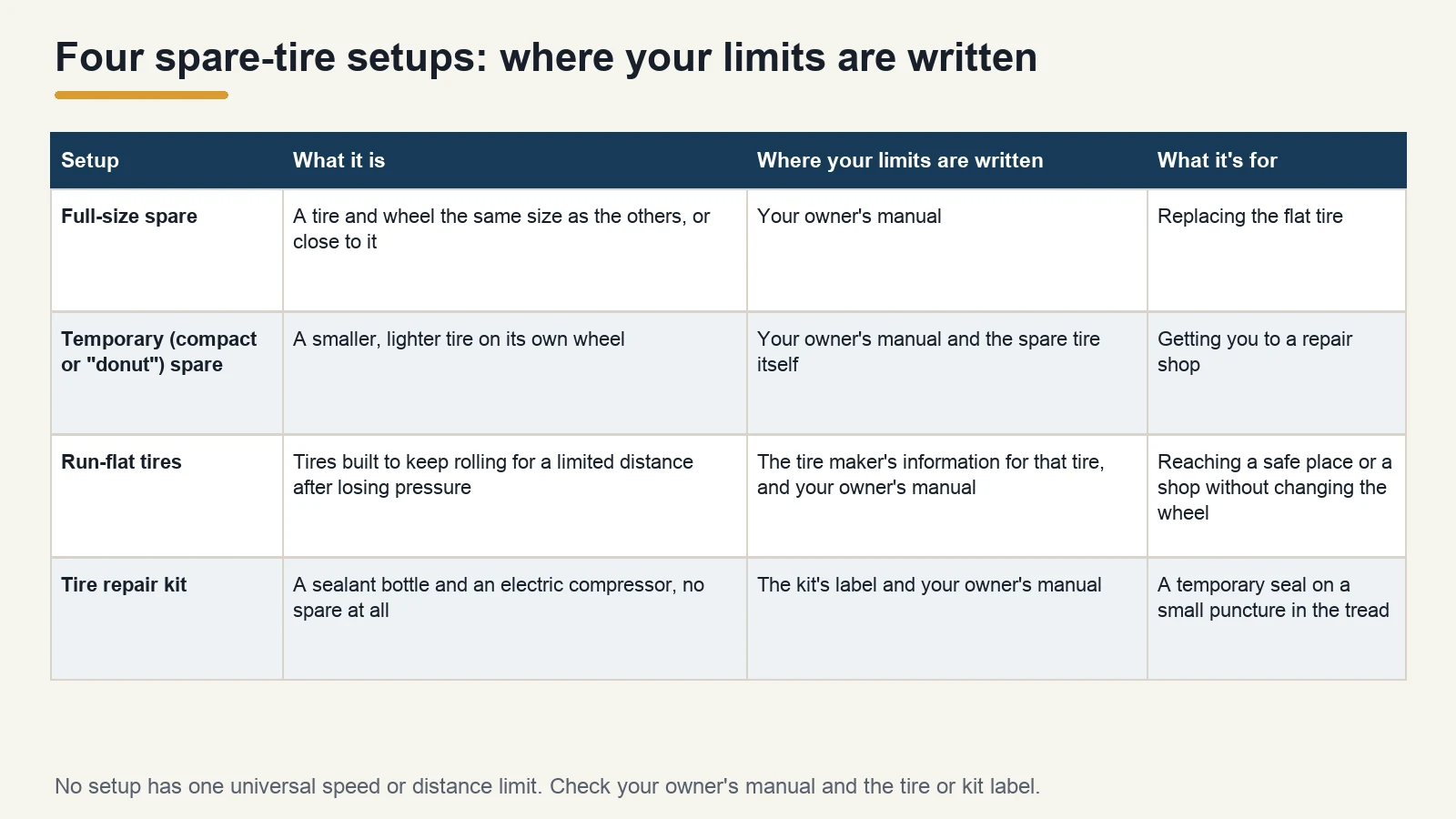
The key point is in the third column: none of these setups has one universal speed or distance limit. Each comes from the vehicle maker or tire maker for that specific product.
Full-size spare
A full-size spare is the simplest case: you change the wheel and keep driving. Even so, check your owner's manual before you rely on it. The manual tells you what the spare is, how to fit it, and whether there are any restrictions on its use. If the spare has been sitting under the floor for years, check its pressure and its age too. Both Michelin and Continental include spare tires in their ten-year replacement guidance, as we cover in our article on how old is too old for a tire.
Temporary (compact or "donut") spare
This is the small spare many cars carry to save space and weight. It's designed to get you to a tire shop, not to stay on the car.
To show what a real manual says, here are a few lines from one Kia owner's manual's "Important - use of compact spare tire" page (2027 edition, checked 1 November 2026). This is one example, not a rule for every car:
- "This tire is smaller than a conventional tire and designed for temporary use only."
- "The compact spare tire is for emergency use only. Do not operate your vehicle on the compact spare at speeds over 50 mph (80 km/h)."
- "The compact spare tire should be inflated to 60 psi (420 kPa)."
- "Do not exceed your vehicle's maximum load rating or the load carrying capacity shown on the sidewall of the compact spare tire."
- "Do not tow a trailer while the compact spare tire is installed."
- "Do not go through an automatic car wash while using the compact spare tire."
The same manual warns that the smaller diameter "reduces the ground clearance approximately 1 in (25 mm)," and says to "Replace it with a proper conventional tire and rim as soon as possible."
Notice what isn't there: this manual gives a speed limit but no distance limit. It simply says to replace the spare as soon as possible. Other manuals may be different, so read the section for your own car, and look at the spare itself for its markings. Our guide to reading a tire sidewall explains what the markings mean.
Two practical points follow from the same page:
- The spare's pressure is often different from your regular tires. Check it when you fit the spare, and check it now and then before you need it. If your gauge and your manual use different units, our tire pressure converter switches between PSI, bar and kPa.
- Only one compact spare should be in use at a time. The manual says so directly: "Do not use more than one compact spare tire at a time."
Run-flat tires
Run-flat tires have reinforced construction that lets them keep supporting the car for a limited distance after losing air. There's no spare to fit, and you keep driving.
How far and how fast is set by the tire maker for its own tires. Continental, for example, says this about its self-supporting runflat (SSR) tires: "You can continue driving for 80 km at a maximum speed of 80 km/h after a tire is punctured." It adds that "you should have the tire checked by a specialist as soon as possible to prevent further damage."
Continental also sets a condition: "You must, however, have a Tire Pressure Monitoring System (TPMS), and Electronic Stability Control (ESC) is recommended." That makes sense. A run-flat can feel normal with no air in it, so the car needs to tell you when it's lost pressure.
Those are Continental's figures for Continental SSR tires. Other brands publish their own information, so check the tire maker's information for the exact tires on your car, and your owner's manual.
Tire repair kits (sealant and compressor)
Many newer cars carry no spare at all. Instead there's a kit: a bottle of sealant and a small compressor that plugs into the car. You inject the sealant, inflate the tire and drive a short distance so the sealant spreads.
It's important to understand what a kit is and isn't. One Hyundai owner's manual (2026 edition, checked 1 November 2026) is clear: "The Tire Mobility Kit is not designed or intended as a permanent tire repair method and is to be used for one tire only." It also says it's "a temporary fix to the tire."
The same manual sets out where a kit can't help:
- "Only punctures located within the tread region of the tire can be sealed using the Tire Mobility Kit."
- "Do not use the Tire Mobility Kit to repair punctures in the tire sidewall."
- "Use of the Tire Mobility Kit may not be effective for tire damage larger than about 0.16 in (4 mm)."
The speed limit for a kit is usually on the kit itself. Kia's manual tells you to "Remove the label with the speed restriction from the sealant bottle and apply it to the steering wheel," so the limit stays in front of you. The Hyundai manual gives one example for after sealing: drive up to 120 mi (200 km), at no more than 50 mph (80 km/h), to reach a service station or tire dealer for replacement. Again, that is one manual's figures for one car. Yours may differ.
Two more things to know before you need it:
- The sealant expires. Kia's manual says to "note the expiration date on the sealant bottle."
- A kit isn't a repair. As Hyundai puts it: "Have your tire repaired as soon as possible."
How to find out what your car has
Don't wait for a flat to find out. Take five minutes now:
- Open the trunk floor (or look under the vehicle, on some SUVs and pickups) and see what's there: a wheel, a kit, or nothing.
- Check the tire sidewalls for run-flat markings, and your owner's manual for what tires the car came with.
- Read the manual's flat-tire section. That's where your car's speed, distance and pressure limits are.
- Check the spare's pressure, or the sealant's expiry date.
After the flat: getting it fixed properly
Whatever got you home, the flat tire still needs attention. Michelin's tire damage guide gives clear advice for the most common case, a nail in the tread: "do not pull it out yourself. Drive carefully to a professional, have the tire removed from the wheel, and have a proper internal inspection and patch-and-plug repair performed." For sidewall damage it's blunter: "A protrusion or bubble indicates an internal structural failure and means the tire must be replaced immediately."
FAQ
How fast can you drive on a donut spare?
Check your owner's manual and the spare itself. Limits are set for each vehicle. One Kia manual, for example, says not to drive on its compact spare "at speeds over 50 mph (80 km/h)," but don't assume your car is the same.
How far can you drive on a spare tire?
It depends on the car and the type of spare. Some manuals give a distance; the Kia manual we quote gives only a speed limit and says to replace the spare as soon as possible. Your manual is the reference.
Is a run-flat better than a spare?
They solve different problems. A run-flat lets you keep driving for a limited distance without changing a wheel; Continental, for example, quotes 80 km at up to 80 km/h for its SSR tires and requires a tire pressure monitoring system. A spare means changing a wheel at the roadside.
Is a tire sealant kit a permanent fix?
No. Hyundai's manual says its kit "is not designed or intended as a permanent tire repair method." It's meant to get you to a shop, and it can't seal sidewall damage.
My car has no spare tire. What do I do?
Find out what it has instead: a repair kit in the trunk, or run-flat tires. Your owner's manual explains which, and gives the limits to follow.